


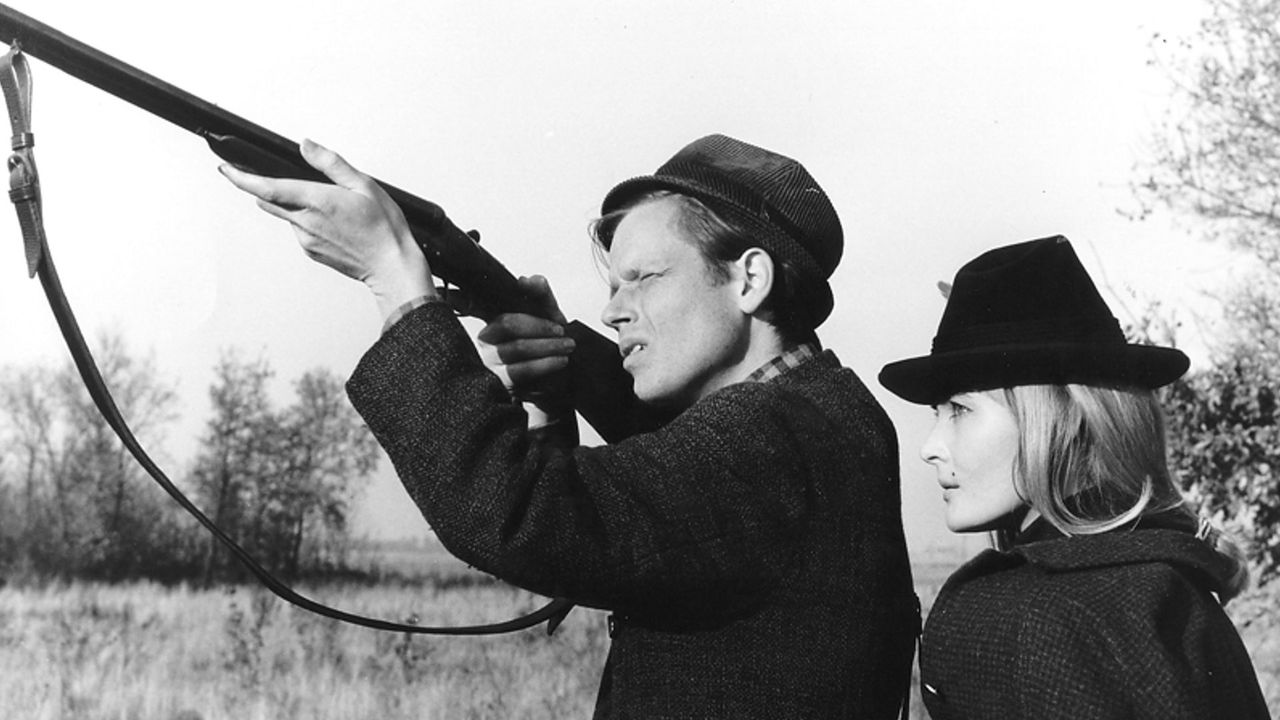
No Shooting Time for Foxes
Drama/Book adaptation, Germany 1966
Two friends from Düsseldorf's upper middle class come to terms with bourgeois society. Even though they have mastered the manners of this society, they have nothing but contempt for it - and are perplexed about their own lives.
Like the foxes they always encounter on the hunts, the intelligent young men keep dodging them, ducking into the undergrowth, celebrating the closed season they have proclaimed for themselves. To escape from this world, Viktor emigrates to Australia and sells hunting weapons. His friend stays in Germany to write as a journalist about things that don't interest him anyway...
After many successful short films, director Peter Schamoni's feature film debut “Schonzeit für Füchse” was invited to compete at the Berlinale in 1966, where his film won the Silver Bear as a special jury prize. In the same year, Hans Posegga received the German Film Award in Gold for Best Music and Edda Seippel for Best Supporting Actress.
As one of the co-signatories, Schamoni finally had the ‘Oberhausen Manifesto’ of 1962 released in feature film form. The novel “Das Gatter” by Günter Seuren served as the literary model. Now the generational conflicts prevailing at the time were also intellectually penetrated and artistically presented in the film.
89 min
HD
FSK 16
German
Awards
Awards
More information
More information
Director:
Template:
Günter Seuren (Novel)
DOP:
Editor:
Composer:
Cast:
Helmut Förnbacher (A Young Man)
Christian Doermer (Viktor)
Andrea Jonasson (Clara)
Monika Peitsch (Lore)
Edda Seippel (Clara's Mother)
Alexander Golling (An Uncle)
Original title:
Schonzeit für Füchse
Original language:
German
Format:
4:3 HD, B/W
Ratings:
FBW "especially valuable"
Age rating:
FSK 16
Audio language:
German